About Sound of Stories 2.0
Sound of Stories 2.0, building on the success of its first edition, aims to support early childhood literacy development through sound-based learning. The initiative addresses the “word gap,” noting that approximately 49% of children enter school with a limited vocabulary, which significantly hinders their long-term academic potential.
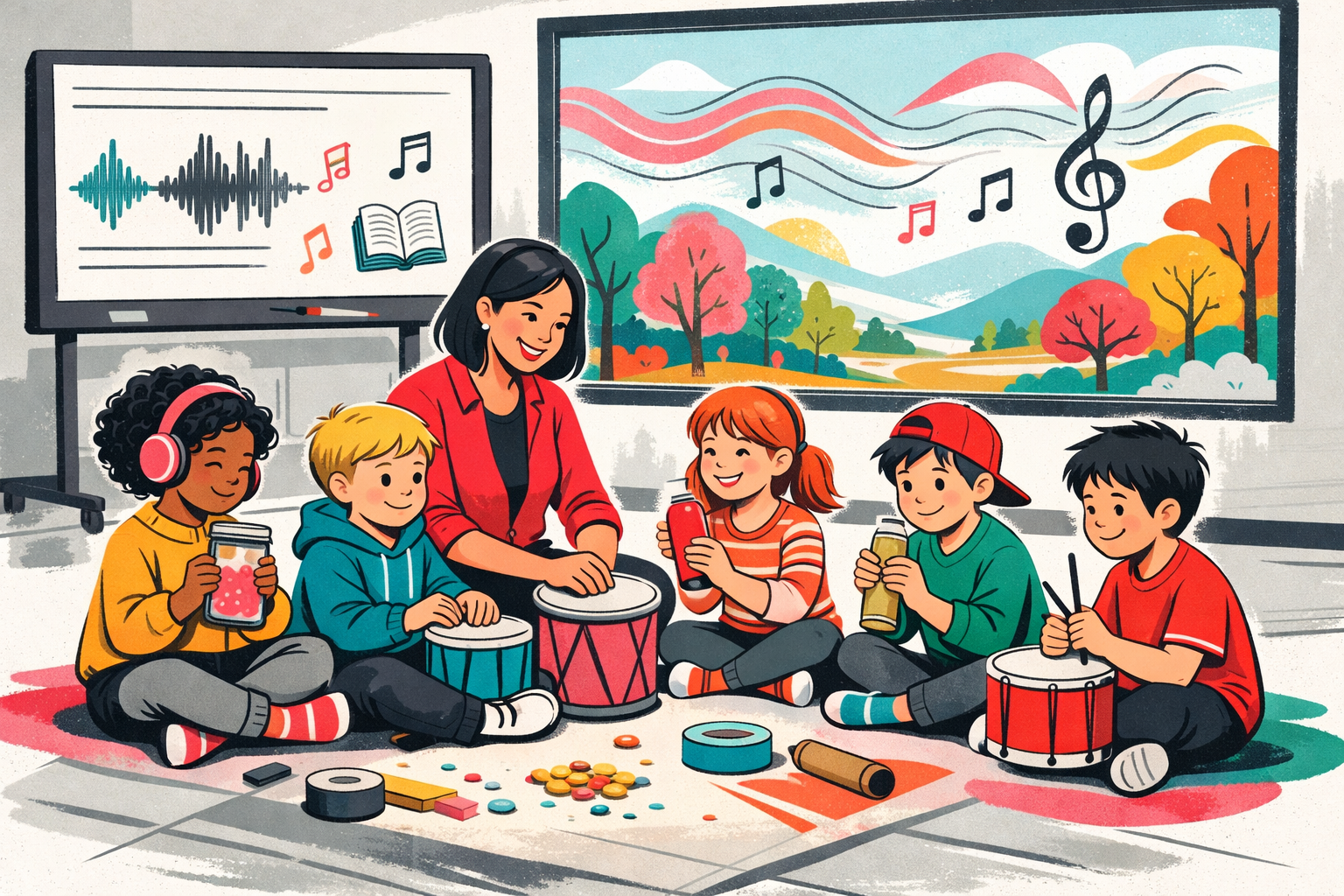
Because traditional education often relies heavily on text-based materials, it can fail to engage students with diverse learning styles or those from disadvantaged backgrounds. By prioritising multisensory soundscapes and audio storytelling, this project creates an inclusive and immersive path to literacy for children aged 3 to 8.
The primary goal of Sound of Stories 2.0 is to enhance children’s literacy, vocabulary, and storytelling skills while fostering critical thinking and creative expression. A major focus is educational inclusion, specifically supporting children affected by Specific Learning Disorders (SLDs) like dyslexia, as well as those facing language barriers or socio-economic challenges. Through auditory stimuli, the project provides alternative ways of processing information that align with diverse learning preferences and reduce reliance on written text.
Furthermore, the project seeks to empower educators by equipping them with innovative pedagogical tools and digital competencies. Key deliverables include an online teacher training course, a Soundscape Database featuring at least 90 recordings, and practical Activity Sheets available in six languages (EN, FR, DK, EL, PL, RO). These resources aim to bridge the digital skills gap among teachers while providing them with flexible, research-backed implementation strategies for the classroom.
Managed by a consortium of six partners from Denmark, Romania, Poland, Belgium, and Greece, the project promotes European cultural diversity and transnational collaboration. All outcomes are developed as Open Educational Resources (OERs), ensuring that high-quality, sound-based literacy tools remain freely accessible to educators across the EU.
🤝 Our partnership
Vesthimmerlands Museum
Denmark
It is a state-recognised museum conducting its own archaeological research. Vesthimmerlands museum also runs Stone Age Centre Ertebølle – an open-air museum- and the “Aggersborg” ring castle, which is the world’s largest Viking fortress, dating to 980 AD, and was added to the UNESCO World Heritage List in September 2023. Museum’s Department of Education runs multiple workshops for groups of all ages, including people with special needs.
Gradinita Step by Step cu Program Prelungit și Program Normal Licurici
Romania
It is a municipal preschool institution that provides full-day child care for 457 children aged 3–6. This kindergarten has a nearly 50-year-old tradition and has been transformed over the years to adapt to new educational requirements. Today, all classrooms have modern facilities and are organised by areas of interest (Science, Art, Library, Constructions, Role-playing games etc.). The varied educational offering, continually enriched through participation in European projects and programs, encourages parents to choose this preschool.
Międzynarodowa Szkoła Podstawowa Edukacji Innowacyjnej w Łodzi
poland
The main aim of the school is to bring up young people who are self-confident and aware of their possibilities, open to the world and to other people, able to take on new challenges, and able to think creatively and in non-standard ways. The school focuses on language education, intercultural and interpersonal skills, and a creative mindset.
The Primary school is open for international pupils. The school puts strong emphasis on developing among students an ability to function in the diversity of national societies. Language education is a key priority for the school, which is why it offers extensive instruction in English, Polish, and German.
The school belongs to the group of Schools of Innovative Education operating nationwide.
Haubro Friskole og Børnehus
Denmark
Private Danish primary school with around 100 pupils aged 6–16 years old and preschool with 45 children aged 0–5 years. Although Haubro is located in a small Danish village, they have a strong network, and both children and adults focus on learning together. Their educational philosophy is a Grundvig-Koldsk approach, which has strong traditional roots in the Danish school system. Their pupils work in an interdisciplinary, project-oriented manner to ensure pupils benefit from the teaching provided.
European Literacy for All Network
Belgium
It is a non-profit organisation focused on enhancing literacy education for all types of learners throughout Europe. ELAN is designed to serve as a key resource and meeting point for professionals in the field of literacy, including educators, researchers, and policymakers. Its primary goal is to gather the experts in the field to facilitate the sharing of scientific information, educational best practices, and the latest insights in teaching and learning.
ELAN’s focus on literacy is in its broad sense: understanding the text, digesting all information, and reading and understanding what has been read. ELAN has a strong focus on inclusion, in the sense of sharing and adapting the created content for everyone, including people with Special learning disorders (SLD). The network recognises and addresses Europe’s linguistic diversity, highlighting the challenges of multilingual literacy education.
Arsakeio Kindergarten of Patras
Greece
The preschool belongs to the oldest educational foundation in Greece – The Society for the Promotion of Education and Learning (Philekpaideftiki Etaireia-Arsakeia- Tositseia Schools), founded in 1836. Philekpaideftiki Etaireia is a public, non-profit welfare foundation that has, over the years, maintained its educational character in line with its founding ideals. Arsakeio Kindergarten School of Patras was founded in 1891. Drawing on the principles of Philekpaideftiki Etaireia, which embrace individuality, empathy, open inquiry, and critical thinking, the preschool fosters every child’s physical, intellectual, linguistic, emotional, and social development. In 2004, Arsakeio was relocated to a new school building in Platani. The preschool premises combine the very best of environmental and building specifications. It’s equipped with a modern science laboratory, sports facilities, an art workshop, a computer lab, and a library.