
The Use of Sounds and Soundscapes in Early Childhood and the Early Years of Primary Education
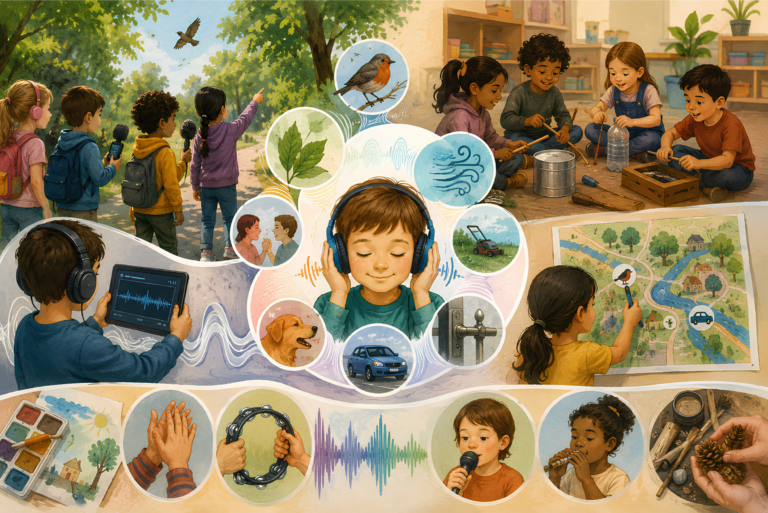
Image generated with AI
Sound as a Learning Tool
The use of sound transforms listening from a passive process into a conscious and active learning experience. Children can learn to pay attention to the sounds around them, identify their sources, compare their characteristics, and discuss the feelings or ideas that these sounds evoke.
This means that educational sound materials are not limited to conventional musical instruments. The voice, the body, everyday objects, and environmental sounds can also provide material for exploration and creative expression. This approach broadens the concept of music and enables children to discover that sound is everywhere and can be transformed into knowledge, play, and artistic expression.
Soundscapes and Active Listening
A soundscape offers children the opportunity to explore the spaces in which they live through listening. The classroom, the school playground, a park, a street, or a natural environment can all become spaces for auditory exploration and investigation.
One particularly effective activity is the soundwalk. Children walk through a familiar environment and focus their attention on the sounds they hear. They can identify:
- natural sounds, such as birds, wind, and leaves
- biological sounds, such as human and animal voices
- human-made sounds, such as vehicles, doors, and machines.
After the walk, children can discuss what they heard and classify the sounds according to their intensity, duration, distance, source, or the emotions they evoke. In this way, the soundwalk combines listening with movement, observation, communication, and environmental exploration.
From Sound to Story
One of the most important educational characteristics of sound is its ability to stimulate imagination and language expression. An unfamiliar sound can become a starting point for questions, descriptions, hypotheses, and stories.
Within the framework of Sound of Stories, sounds can provide the starting point for creating sound stories. Children can combine:
- spoken language and narration
- human voices
- body sounds
- objects
- music
- environmental recordings.
For younger children, the process can begin with simple questions such as: What did you hear? Who or what made this sound? Where are we? What does it remind you of, or how does it make you feel? In this way, listening is directly connected to vocabulary development, storytelling, communication, and creative thinking.
Sound Mapping and Creative Production
Another engaging activity is sound mapping. Children create a map of a familiar space and mark where they heard particular sounds. In this way, the invisible auditory dimension of a space becomes visible.
These activities can be adapted to the children’s age. Younger children can use drawings and simple symbols, while older children can create more complex maps and combine them with digital sound recordings.
At the same time, children can create their own soundscapes by selecting, combining, and transforming sounds. Through this process, they are not simply listeners but become active sound researchers, creators, and storytellers.
Digital Tools and Participation
The use of digital tools can expand the possibilities for sound recording and creative production. Tablets, smartphones, and simple recording applications allow children to collect sounds from their environment and transform them into digital stories or sound compositions.
However, technology should function as a means rather than an end in itself. Its educational value lies in its ability to help children listen more carefully, make choices, collaborate, and communicate their experiences.
At the same time, this approach offers important opportunities for inclusive participation, as every child can contribute in different ways: by listening, speaking, drawing, moving, recording, or creating sounds.
References
Adams, D., & Beauchamp, G. (2021). The impact of music making outdoors on primary school aged pupils (aged 7–10 years) in the soundscape of nature from the perspective of their primary school teachers. Journal of Outdoor and Environmental Education, 24, 37–53.
Ahern, K. F. (2022). Soundscaping learning spaces: Online synchronicity and composing multiple sonic worlds. Postdigital Science and Education, 4, 160–176.
Kurukose Cal, H. K., Kang, J., & Aletta, F. (2024). Methodological approaches and main factors considered in school soundscape studies: A scoping review. Building Acoustics, 31(1), 75–90.
Shu, S. (2023). Exploring the role of soundscape in restorative experience: A pilot study from children’s perspective. Frontiers in Psychology, 14, 1131170.