When the museum started listening
The reader may wonder why teaching sound and soundscapes has become an essential part of the teaching department’s work at Vesthimmerlands Museum in Denmark. The story is a bit of an adventure.
Once upon a time – yes, that’s how the story begins best when you come from Hans Christian Andersen’s country – there was a teacher in the school service at Vesthimmerlands Museum who received a question from music anthropologist Eva Fock[1]: Could the school service see a teaching potential in the Stone Age where the starting point was: sound, instrument building and archaeology?
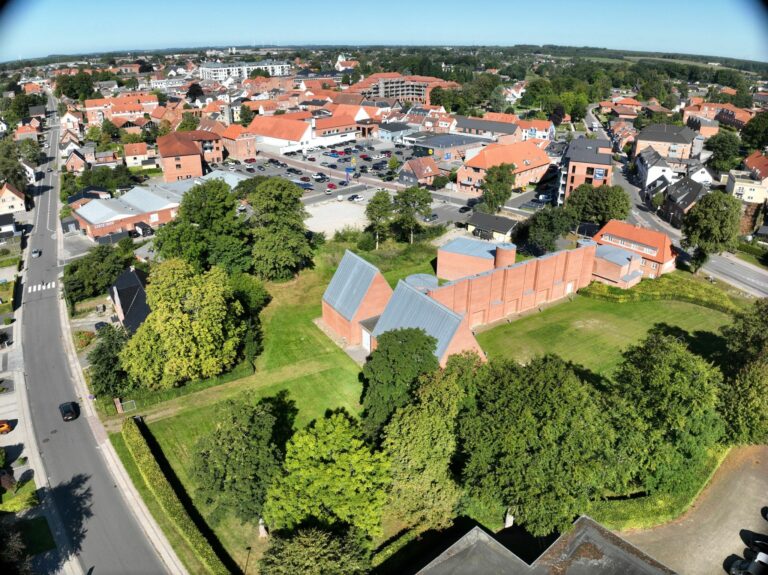
Vesthimmerlands Museum, Aars, Denmark
The project, The Sound of Ancient Times [2] became an introduction to a wondrous universe and set off a true snowball effect. Suddenly, sound, sound recordings and the work with the conceptual world of sound came into focus, with archaeological knowledge in the teaching. At the same time, it became clear how poor our language really is at describing sound. For example, try putting into words the sound of a wet car tyre against asphalt. Or what rain sounds like when it falls on trees. It is surprisingly difficult.
Through collaboration with sound researcher Ingeborg Okkels[3], new methods, sound language, and tools were introduced. At the same time, we became aware of research that showed that about 30% of Danish 6-year-olds had a vocabulary similar to that of a 3-year-old. Here, the connection became clear: The work with sound is precisely about putting sensory experiences into words and strengthening the language through cultural heritage education.
Experience has shown that working with sound is highly motivating for secondary school students. Therefore, the obvious question arose: Could the methods also be used with younger children?
Thus, Sound of Stories was born – a small-scale Erasmus+ project with partners from Belgium, Denmark, Poland and the Czech Republic. The project worked with, among other things:
- The benefits of using audio in education
- Collecting soundscapes and building a sound library
- Audio stories and teaching courses
The audio library also included Reconstructed Ancient Soundscapes (RAS). Here, sounds and soundscapes were collected at open-air museums such as the Iron Age village of Hvolris, the Stone Age Centre Ertebølle and the Medieval Centre.
The first version of Sound of Stories generated considerable interest, especially among educators and teachers. The materials have been downloaded many thousands of times. The test courses also created a demand for a course in the use of sound in teaching.
This brings us to the next chapter in the story: the recently launched Sound of Stories 2.0.
But why does sound have such a strong effect in teaching – and what actually happens when students start actively listening to cultural heritage? We’ll dive into that in the next part. Then, “Stay tuned” is a phrase used in Sound of Stories 2.0.
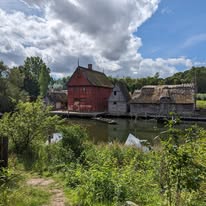
The Medieval Center at the island Lolland. Photo: Vesthimmerlands Museum, Denmark
Footnotes
[1] Eva Fock: Music anthropologist www.earswideopen.dk
[2] Lyden af Oldtiden: www.lydenafoldtiden.dk (translated: The sound of the ancient)
[3] Ingeborg Okkels: www.lydvaerk.dk